




 View My Stats
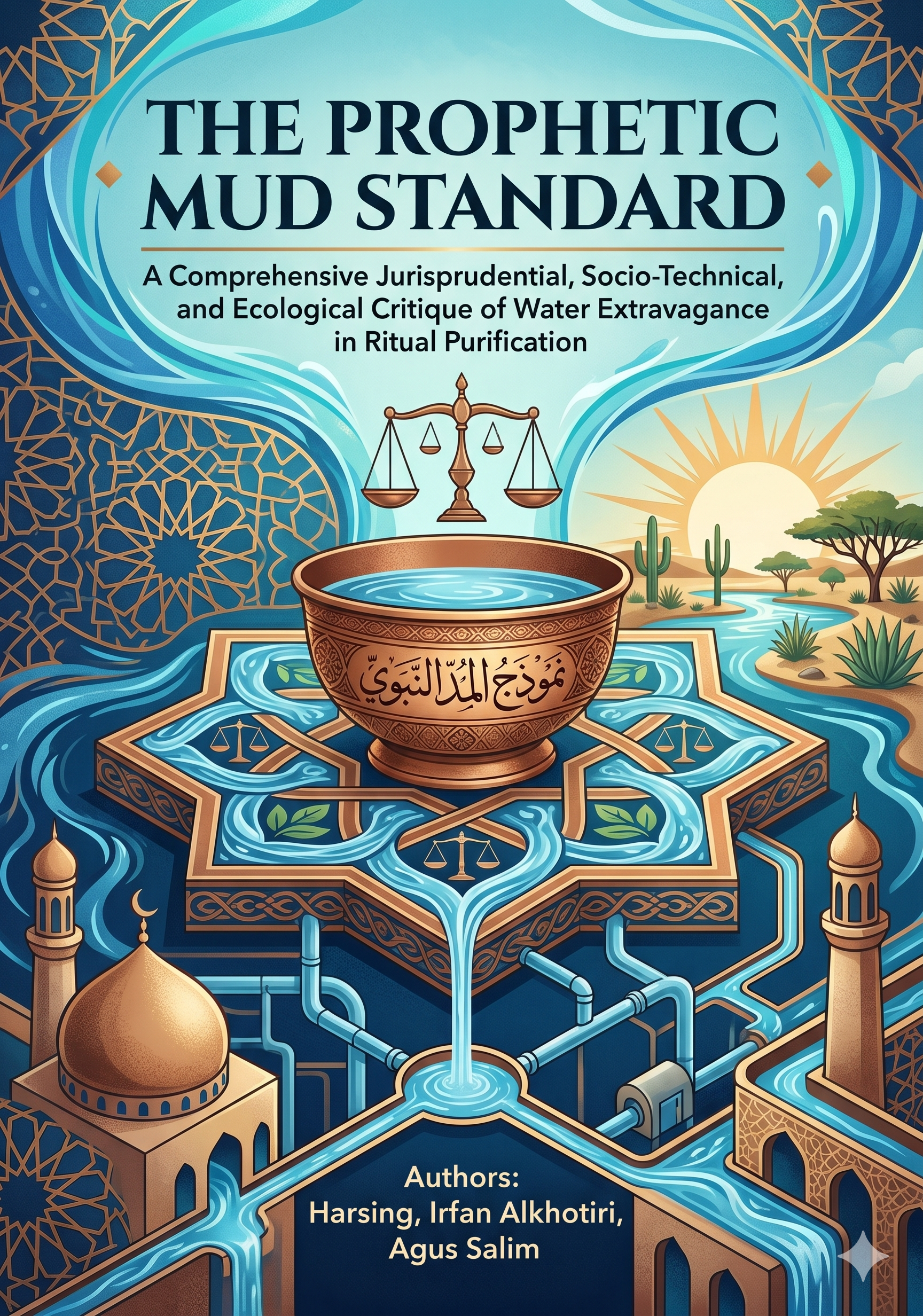
The Prophetic Mud Standard: A Comprehensive Jurisprudential, Socio-Technical, and Ecological Critique of Water Extravagance in Ritual Purification
- Authors
-
-
Harsing Harsing
Sekolah Tinggi Agama Islam Minhajul HaqAuthor -
Irfan Alkhotiri
Sekolah Tinggi Agama Islam Minhajul HaqAuthor -
Agus Salim
Sekolah Tinggi Agama Islam Minhajul HaqAuthor
-
- Keywords:
- Ritual Ablution, Water Conservation, Israf, Prophetic Mud, Green Mosque, Environmental Fiqh
- Abstract
-
Ritual purification (Wudu) is a fundamental Islamic practice, yet contemporary implementation often results in significant water waste (Israf). This study analyzes the Prophetic benchmark of one Mud—approximately 600 to 775 ml—against modern consumption patterns in mosques. Using a mixed-methods approach, including historical metrological analysis and a review of empirical data from Indonesian mosques, the research identifies a socio-technical mismatch between traditional values and modern plumbing systems. Findings indicate that modern practitioners consume between 2.47 and 7 liters per Wudu, representing a 300% to 1100% deviation from the Sunnah. The study proposes a synergistic model combining technical interventions, such as Water-Efficient Aerators (WEAs) and "transparent tank" designs, with behavioral changes rooted in "Ecological Tauhid." Implementation of these strategies can achieve up to a 76% reduction in water usage, aligning contemporary worship with global sustainability goals.
- References
-
Al-Bukhari, M. (2001). Shahih al-Bukhari.
Muslim bin al-Hajjaj. (2006). Shahih Muslim.
Widoretno, S., & Ardiansyah, M. (2025). Analysis of the Efficiency of Using Water for Wudu in Modern Mosque Plumbing Systems. Jurnal Riset Rumpun Ilmu Teknik.
Faruqui, N. I., et al. (2001). Water Management in Islam. IDRC.
Hinz, W. (1955). Islamische Masse und Gewichte.
Kadaria. (2022). Study of Rainwater Potential as Raw Water Source for Campus Mosque. J. Presipitasi.
Afiatun, E., et al. (2022). Potential Utilization of Recycling Ablution Used Water. Journal of Community Based Environmental Engineering.
Hamdi, F. (2025). Integrating Maqashid al-Sharia and Islamic Ethics for Sustainable Water Management. Al-Ahkam.
Al-Mamun, A. (2014). Water consumption for ablution in IIUM Masjid. Advances in Environmental Biology.
Sukarni. (2024). Development and Concept of Environmental Fiqh. Syariah: Jurnal Hukum dan Pemikiran.
Zaied, R. A. (2017). Water tap design for ablution and cultural influences. Frontiers in Environmental Science.
Khalid, F. (2019). Signs on the Earth: Islam, Modernity and the Climate Crisis.
Irfan, A. N., et al. (2022). Analisis kebutuhan dan persepsi penggunaan air bersih untuk bersuci. ENVIRO.
Muazaroh, D. (2020). Ecological Da'wah framework. Muharrik.
Widoretno, S., et al. (2025). Edukasi Desain Plumbing Masjid Modern. Kontribusi: Jurnal Penelitian.
Alsubaie, M. (2018). The Miqat of al-Juhfa: A Historical and Archaeological Study.
Mulyadi, et al. (2024). Effectiveness of Islamic Values on Environmental Awareness. Scaffolding.
Dadach, Z. E. (2026). Natural Sciences in the Mirror of Islam.
Lubis, M. N. (2022). Desain Sistem Penggunaan Kembali Limbah Air Wudhu. Jurma.
Johari, et al. (2013). Water usage during ablution practices.
Uthman. (2015). Impact of Ibadi jurisprudence on Islamic architectural forms..
Khidhir, A. (2024). Political Resistance in Qur'anic Legal Exegesis. Mutawatir..
Barbier, et al. (2019). Automated water tap systems for ablution.
Alpiansyah, R., Alkhotiri, I., & Harsing. (2026). ENHANCING COMMUNITY LEGAL LITERACY AS AN EFFORT TO OVERCOME THE WEAKNESSES OF THE CONSUMER PROTECTION SYSTEM IN GOODS PURCHASE TRANSACTIONS. Al Musa’adah : Journal of Community Service STAI Minhajul Haq, 1(1), 1-10. https://doi.org/10.66891/4r7z1x04
EPA WaterSense. (2025). Certified water-efficient aerators performance.
Al-Ghamdi, S. G. (2016). Sustainable water management in mosques: Saudi Arabia. Journal of Cleaner Production.
Nawawi, et al. (2024). Eco-pesantren and Islamic education.
Pranoto, R., Abdurahman, I., Salim, A., Alkhotiri, I., & Alpiansyah, R. (2026). Empowering Student Dormitory Laundry Businesses in Pusakamulya Village: A Strategic Professionalization for Enhancing Community Economic Quality. Al Musa’adah : Journal of Community Service STAI Minhajul Haq, 1(1), 51-60. https://doi.org/10.66891/avk73z56
- Cover Image
-
- Downloads
- Published
- 2026-06-30
- Section
- Articles
- License
-

This work is licensed under a Creative Commons Attribution-ShareAlike 4.0 International License.
You are free to:
- Share — copy and redistribute the material in any medium or format for any purpose, even commercially.
- Adapt — remix, transform, and build upon the material for any purpose, even commercially.
- The licensor cannot revoke these freedoms as long as you follow the license terms.
Under the following terms:
- Attribution — You must give appropriate credit , provide a link to the license, and indicate if changes were made . You may do so in any reasonable manner, but not in any way that suggests the licensor endorses you or your use.
- ShareAlike — If you remix, transform, or build upon the material, you must distribute your contributions under the same license as the original.
- No additional restrictions — You may not apply legal terms or technological measures that legally restrict others from doing anything the license permits.
Notices:
You do not have to comply with the license for elements of the material in the public domain or where your use is permitted by an applicable exception or limitation .
No warranties are given. The license may not give you all of the permissions necessary for your intended use. For example, other rights such as publicity, privacy, or moral rights may limit how you use the material.
How to Cite
Similar Articles
- Isrun Abdurahman, Harsing, Irfan Alkhotiri, Integrating Classical Jurisprudence and Modern Medicine: A Comprehensive Study of Menstruation, Postpartum Bleeding, and Chronic Vaginal Discharge in Islamic Law , Mutamayyiz: Journal of Islamic Studies: Vol. 1 No. 1 (2026): Mutamayyiz: Journal of Islamic Studies
- Rizaldy Alpiansyah, Rohman Pranoto, Agus Salim, Miftah Wangsadanureja, Tatang Hidayat, A REVIEW OF FIQH MUAMALAH ON CONSUMER PROTECTION IN THE E-COMMERCE ERA: AN ANALYSIS OF PERSONAL DATA, REFUND POLICIES, AND STANDARD CLAUSES , Mutamayyiz: Journal of Islamic Studies: Vol. 1 No. 1 (2026): Mutamayyiz: Journal of Islamic Studies
You may also start an advanced similarity search for this article.
Most read articles by the same author(s)
- Isrun Abdurahman, Harsing, Irfan Alkhotiri, Integrating Classical Jurisprudence and Modern Medicine: A Comprehensive Study of Menstruation, Postpartum Bleeding, and Chronic Vaginal Discharge in Islamic Law , Mutamayyiz: Journal of Islamic Studies: Vol. 1 No. 1 (2026): Mutamayyiz: Journal of Islamic Studies
- Rizaldy Alpiansyah, Rohman Pranoto, Agus Salim, Miftah Wangsadanureja, Tatang Hidayat, A REVIEW OF FIQH MUAMALAH ON CONSUMER PROTECTION IN THE E-COMMERCE ERA: AN ANALYSIS OF PERSONAL DATA, REFUND POLICIES, AND STANDARD CLAUSES , Mutamayyiz: Journal of Islamic Studies: Vol. 1 No. 1 (2026): Mutamayyiz: Journal of Islamic Studies
- Rizaldy Alpiansyah, Isrun Abdurahman, Irfan Alkhotiri, Miftah Wangsadanureja, Dzulfikri, DECONSTRUCTING THE HISTORICAL NARRATIVE: A CRITICAL REVIEW OF THE ABSENCE OF A CONSTRUCTIVE ROLE OF THE SHIA FACTION IN THE PAST, PRESENT, AND FUTURE OF ISLAMIC CIVILIZATION , Mutamayyiz: Journal of Islamic Studies: Vol. 1 No. 1 (2026): Mutamayyiz: Journal of Islamic Studies
- Isrun Abdurahman, Rohman Pranoto, Agus Salim, Rizaldy Alpiansyah, Irfan Alkhotiri, INTERNALISASI NILAI KARAKTER ANAK MELALUI PENGULANGAN SURAT AL-FATIHAH: SEBUAH SINTESIS KOMPREHENSIF BERDASARKAN NEUROSAINS, PSIKOLOGI PENDIDIKAN, DAN TEOLOGI ISLAM , Mutamayyiz: Journal of Islamic Studies: Vol. 1 No. 1 (2026): Mutamayyiz: Journal of Islamic Studies