




 View My Stats
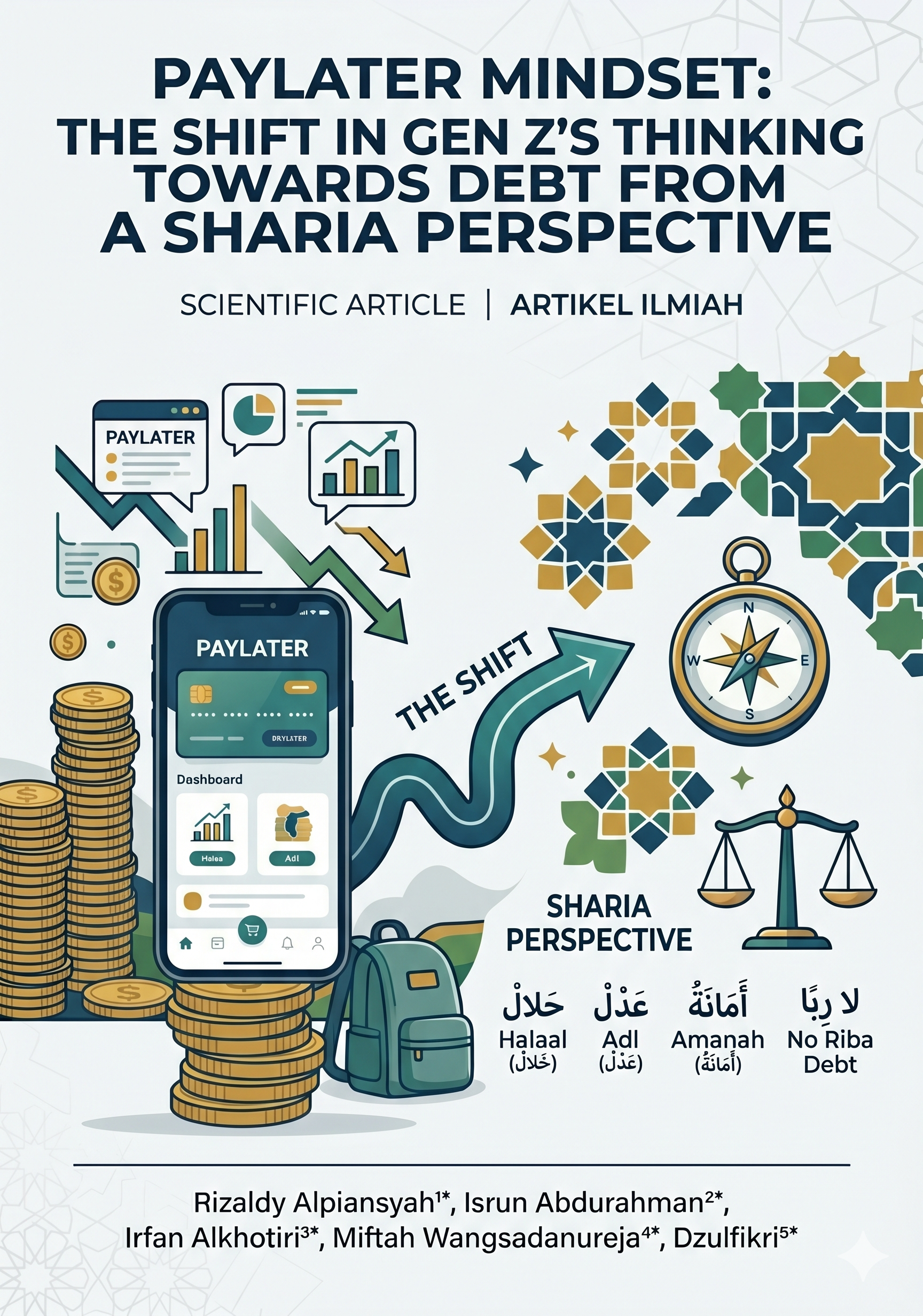
Paylater Mindset: The Shift in Gen Z's Thinking Towards Debt from a Sharia Perspective
- Authors
-
-
Rizaldy Alpiansyah
Sekolah Tinggi Agama Islam Minhajul HaqAuthor -
Isrun Abdurahman
Sekolah Tinggi Agama Islam Minhajul HaqAuthor -
Irfan Alkhotiri
Sekolah Tinggi Agama Islam Minhajul HaqAuthor -
Miftah Wangsadanureja
Sekolah Tinggi Ilmu Al-Qur'an (STIQ) ZAD, Cianjur, IndonesiaAuthor -
Dzulfikri
University of BakhtalrudaAuthor
-
- Keywords:
- Gen Z debt behavior, Islamic finance ethics, Paylater Mindset, Sharia Perspective
- Abstract
-
Digital disruption in the modern economic landscape has given birth to financial technology (fintech) instruments that radically change the consumption patterns and financial governance of society globally and nationally. One of the most dominating innovations that has sparked sharp discourse is the Buy Now, Pay Later (BNPL) service, more popularly known as paylater. Generation Z (Gen Z) and Millennials are recorded as the largest demographic of users in this service ecosystem, where the total outstanding paylater debt in Indonesia reached an aggregate figure of Rp29.59 trillion in April 2025, with a Non-Performing Loan (NPL) ratio that continues to creep up. This scientific report presents a comprehensive, in-depth, and nuanced analysis of the fundamental shift in Generation Z's mindset towards the concept of debt due to paylater penetration, evaluated strictly through the lens of Islamic economics, Fiqh Muamalah, and Maqashid Sharia. Through a synthesis of empirical data from the Financial Services Authority (OJK), behavioral economics literature, and fatwas from the National Sharia Board of the Indonesian Ulema Council (DSN-MUI), this research identifies an acute sociological shift: debt, which in Islamic tradition is inherently viewed as an emergency instrument based on mutual assistance (tabarru'), is now commodified into a lifestyle based on instant gratification and a "self-reward" culture that reduces the psychological friction of shopping (pain of paying). Furthermore, the analysis in this report outlines contemporary Fiqh Muamalah resolutions regarding the schemes of Istijrar, Murabahah, Wakalah bil Ujrah, Qardh, and Kafalah to strictly differentiate between conventional paylater and sharia paylater facilities. Within the framework of Maqashid Sharia, the normalization of consumptive debt among Gen Z is proven to be diametrically opposed to the principle of Hifz al-Mal (protection of wealth), triggering systemic threats in the form of israf (extravagance) and tabzir (extreme wastefulness). In conclusion, the report asserts that without structured, massive, and digitally integrated Islamic financial literacy interventions, the ease of access to instant credit can transform from a tool of financial inclusion into a trap of long-term financial fragility that undermines the economic resilience of future generations.
- References
-
Asnaini, A., Polindi, M., & Triyana, T. (2024). Analisis Perilaku Konsumtif Pengguna Layanan Buy Now Pay Later dalam Konsep Konsumsi Menurut Muhammad Abdul Mannan. Jesya (Jurnal Ekonomi Dan Ekonomi Syariah), 7(2), 1445-1456. https://doi.org/10.36778/jesya.v7i2.1605
Astuti, M. D., & Wardani, M. K. (2024). Pengaruh Kemudahan Penggunaan Paylater Terhadap Perilaku Konsumtif dengan Lifestyle sebagai Pemoderasi. MASTER: Jurnal Manajemen Strategik Kewirausahaan, 4(2). https://doi.org/10.37366/master.v4i2.1481
Alpiansyah, R., Alkhotiri, I., & Harsing. (2026). ENHANCING COMMUNITY LEGAL LITERACY AS AN EFFORT TO OVERCOME THE WEAKNESSES OF THE CONSUMER PROTECTION SYSTEM IN GOODS PURCHASE TRANSACTIONS. Al Musa’adah : Journal of Community Service STAI Minhajul Haq, 1(1), 1-10. https://doi.org/10.66891/4r7z1x04
Dewan Syariah Nasional–Majelis Ulama Indonesia. (2018). Fatwa No. 117/DSN-MUI/II/2018 tentang layanan pembiayaan berbasis teknologi informasi berdasarkan prinsip syariah. Jakarta: DSN–MUI.
Meilan, D. (2023). Pandangan Ekonomi Syariah Islam Terhadap Pembayaran PayLater. Azzahra: Jurnal Ekonomi Syariah, Artikel Perspektif Ekonomi Syariah Istijrar. Retrieved from https://journal.an-nur.ac.id/index.php/azzahra/article/view/1881
Mustika, R., Sudirman, I. F., & Burhani, H. H. (2025). Literasi keuangan syariah dan transformasi digital: Analisis Perilaku Gen Z dalam pengunaan fintech. Journal of Accounting and Digital Finance, 5(1), 109.
Otoritas Jasa Keuangan (OJK). (2024). Strategi Nasional Literasi Keuangan Indonesia (SNLKI) 2021-2025. Jakarta: Publikasi OJK. Retrieved from https://www.ojk.go.id
Otoritas Jasa Keuangan (OJK). (2024). Survei Nasional Literasi dan Inklusi Keuangan (SNLIK) 2024. Publikasi E-Magazine Edukasi Konsumen Triwulan IV 2024.
Otoritas Jasa Keuangan (OJK). (2025). Survei Nasional Literasi dan Inklusi Keuangan (SNLIK) 2025. Publikasi E-Magazine Edukasi Konsumen Tw II 2025.
Restike, K. P., Prasasti, D., Fitriani, D. I., & Ciptani, M. K. (2024). Pengaruh Literasi Keuangan, Perilaku Pembelian Impulsif, Dan Gaya Hidup Terhadap Penggunaan Shopee Paylater Gen Z. Jurnal Akuntansi Bisnis, 22(1), 100-113.
Sarifuddin, S. (2025). This study examines the adoption of Buy Now, Pay Later (BNPL) services among Generation Z consumers in Klang Valley, Malaysia. International Journal of Social Policy and Society (IJSPS), 21.
Pranoto, R., Abdurahman, I., Salim, A., Alkhotiri, I., & Alpiansyah, R. (2026). Empowering Student Dormitory Laundry Businesses in Pusakamulya Village: A Strategic Professionalization for Enhancing Community Economic Quality. Al Musa’adah : Journal of Community Service STAI Minhajul Haq, 1(1), 51-60. https://doi.org/10.66891/avk73z56
Tempo. (2024). Millennials and Gen Z drive Indonesia's Rp29.59 trillion Paylater debt. Tempo English. Retrieved from https://en.tempo.co/read/2014263/millennials-and-gen-z-drive-indonesias-rp29-59-trillion-paylater-debt
Tirto.id. (2024). Tren Fintech 2024. Retrieved from https://tirto.id/tren-fintech-2024-jumlah-pengguna-paylater-naik-g2Xx
Warliani, L. (2025). Fenomena paylater: tren 'beli sekarang, bayar nanti' yang menjadi sorotan. Koran Mandala.
Yesidora, A. (2025). Riset PEFINDO: Gen Z dan Milenial dominasi paylater, mayoritas untuk QRIS. Katadata Fintech. Retrieved from https://katadata.co.id/digital/fintech/6788f74ca867b/riset-pefindo-gen-z-dan-milenial-dominasi-paylater-mayoritas-untuk-qris
- Cover Image
-
- Downloads
- Published
- 2026-05-31
- Section
- Articles
How to Cite
Similar Articles
- Rohman Pranoto, Isrun Abdurahman, Rizaldy Alpiansyah, Miftah Wangsadanureja, Tatang Hidayat, ADOPTION OF SHARIA FINTECH AND THE PAYLATER ECOSYSTEM: A COMPREHENSIVE ANALYSIS OF GENERATION Z'S IMPULSIVE BUYING BEHAVIOR WITHIN THE SPECTRUM OF MAQASHID SHARIA AND FINANCIAL RESILIENCE , Dirham : Journal of Islamic Economics: Vol. 1 No. 1 (2026): Dirham : Journal of Islamic Economics
- Asep Hasan Sulaeman, Rohman Pranoto, Cahyudi Prima, Tatang Hidayat, Miftah Wangsadanureja, Analysis of the Role of Productive Waqf as a Fiscal Policy Instrument in Islamic Economic , Dirham : Journal of Islamic Economics: Vol. 1 No. 1 (2026): Dirham : Journal of Islamic Economics
- Rohman Pranoto, Isrun Abdurahman, Cahyudi Prima, Rizaldy Alpiansyah, Irfan Alkhotiri, FINANCIAL MANAGEMENT ANALYSIS OF MINHAJUL HAQ ISLAMIC BOARDING SCHOOL IN PURWAKARTA , Dirham : Journal of Islamic Economics: Vol. 1 No. 1 (2026): Dirham : Journal of Islamic Economics
- Rohman Pranoto, Isrun Abdurahman, Rizaldy Alpiansyah, Miftah Wangsadanureja, Tatang Hidayat, EKONOMI KREATIF DALAM METAVERSE: TINJAUAN EKSTENSIF TRANSAKSI ASET DIGITAL DAN HAK KEPEMILIKAN (MILKIYYAH) DALAM PERSPEKTIF FIKIH MUAMALAH BAGI KREATOR MUDA , Dirham : Journal of Islamic Economics: Vol. 1 No. 1 (2026): Dirham : Journal of Islamic Economics
You may also start an advanced similarity search for this article.
Most read articles by the same author(s)
- Rohman Pranoto, Isrun Abdurahman, Rizaldy Alpiansyah, Miftah Wangsadanureja, Tatang Hidayat, EKONOMI KREATIF DALAM METAVERSE: TINJAUAN EKSTENSIF TRANSAKSI ASET DIGITAL DAN HAK KEPEMILIKAN (MILKIYYAH) DALAM PERSPEKTIF FIKIH MUAMALAH BAGI KREATOR MUDA , Dirham : Journal of Islamic Economics: Vol. 1 No. 1 (2026): Dirham : Journal of Islamic Economics
- Rohman Pranoto, Isrun Abdurahman, Rizaldy Alpiansyah, Miftah Wangsadanureja, Tatang Hidayat, ADOPTION OF SHARIA FINTECH AND THE PAYLATER ECOSYSTEM: A COMPREHENSIVE ANALYSIS OF GENERATION Z'S IMPULSIVE BUYING BEHAVIOR WITHIN THE SPECTRUM OF MAQASHID SHARIA AND FINANCIAL RESILIENCE , Dirham : Journal of Islamic Economics: Vol. 1 No. 1 (2026): Dirham : Journal of Islamic Economics
- Rohman Pranoto, Isrun Abdurahman, Cahyudi Prima, Rizaldy Alpiansyah, Irfan Alkhotiri, FINANCIAL MANAGEMENT ANALYSIS OF MINHAJUL HAQ ISLAMIC BOARDING SCHOOL IN PURWAKARTA , Dirham : Journal of Islamic Economics: Vol. 1 No. 1 (2026): Dirham : Journal of Islamic Economics
- Asep Hasan Sulaeman, Rohman Pranoto, Cahyudi Prima, Tatang Hidayat, Miftah Wangsadanureja, Analysis of the Role of Productive Waqf as a Fiscal Policy Instrument in Islamic Economic , Dirham : Journal of Islamic Economics: Vol. 1 No. 1 (2026): Dirham : Journal of Islamic Economics