




 View My Stats
PAI LEARNING IN INTEGRATED SCHOOLS, ISLAMIC BOARDING SCHOOLS, AND INTERNATIONAL SCHOOLS
- Authors
-
-
Harsing
Sekolah Tinggi Agama Islam Minhajul HaqAuthor -
Rizaldy Alpiansyah
Sekolah Tinggi Agama Islam Minhajul HaqAuthor -
Irfan Alkhotiri
Sekolah Tinggi Agama Islam Minhajul HaqAuthor
-
- Keywords:
- INTEGRATED SCHOOLS, ISLAMIC BOARDING SCHOOLS, INTERNATIONAL SCHOOLS
- Abstract
-
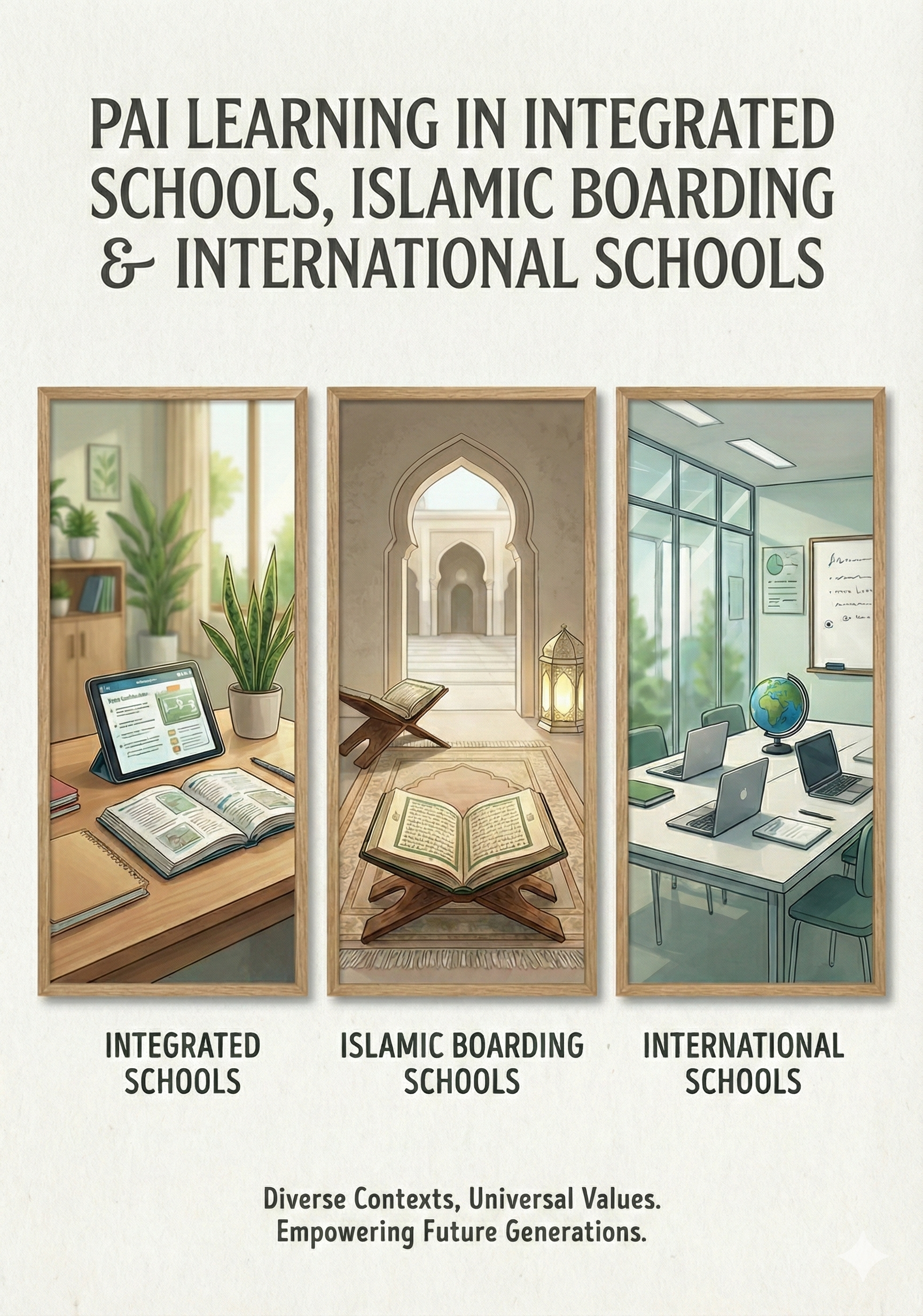
This study aims to analyze and compare the learning model of Islamic Religious Education (PAI) in three types of educational institutions, namely Integrated Schools, Islamic Boarding Schools, and International Schools. This study uses a qualitative approach with a descriptive-comparative method, where data is obtained through observation, interviews, and document review. The results of the study show that each type of school has different characteristics and approaches in PAI learning. Integrated Schools emphasizes the integration between the national curriculum and Islamic values, so that the learning process is oriented towards a balance between academic and spiritual aspects. Islamic Boarding School develops a learning model based on the pesantren environment, with a focus on character formation and strengthening the memorization of the Qur'an. Meanwhile, the International School applies a multicultural and global approach, where PAI is taught in a method that is adaptive to the international context. A comparison of the three models shows that the advantages of PAI learning can be achieved by combining the strengths of each system.
- References
-
Abdullah, A. (2017). Islamic education in a multicultural perspective. Student Library.
Abdullah, M. A. (2010). Islamic religious education in multicultural schools: Integration of values and knowledge in the national education system. Pustaka Siswa.
Azra, A. (2012). Islamic education: Tradition and modernization in the midst of the challenges of the third millennium. Kencana.
Basri, H. (2021). PAI learning model in international-based schools: Challenges and curriculum adaptation strategies. Al-Tarbawi: Journal of Islamic Education, 14(2), 113–128.
Daulay, H. P. (2014). Islamic education in the national education system in Indonesia. Kencana.
Dhofier, Z. (2011). The tradition of Islamic boarding schools: A study of kyai's life and his vision of the future of Indonesia. LP3ES.
Majid, A., & Andayani, D. (2013). Competency-based Islamic religious education: Curriculum concept and implementation 2013. Remaja Rosdakarya.
Muhaimin. (2004). Islamic education paradigm: Efforts to increase the effectiveness of Islamic religious education in schools. Remaja Rosdakarya.
Nata, A. (2012). Islamic education management: Developing superior and competitive Islamic educational institutions. Kencana.
Rahman, F. (2019). PAI learning model in the context of international schools in Indonesia. Journal of Islamic Studies and Education, 4(2), 90–105.
Supian, Y., Alpiansyah, R., & Alkhotiri, I. (2026). Deep Learning and Implementastion in Islamic education. Bahrul Ilmi : Journal of Islamic Religious Education, 1(1), 1-14. https://doi.org/10.66891/ft6c5w58
TATA KUSUMA, D., Alkhotiri, I., & Alpiansyah, R. (2026). THE RELATIONSHIP BETWEEN PERSONALITY COMPETENCE OF ISLAMIC RELIGIOUS EDUCATION TEACHERS AND STUDENT DISCIPLINE, MORALS, AND RESPONSIBILITY AT SMA NEGERI 1 BANDUNG CITY. Bahrul Ilmi : Journal of Islamic Religious Education, 1(1), 15-27. https://doi.org/10.66891/err47p48
Tilaar, H. A. R. (2017). Multiculturalism: Global challenges and the transformation of national education. Grasindo.
Zuhairini, et al. (2015). Methodology of Islamic religious education. Bumi Aksara.
- Cover Image
-
- Downloads
- Published
- 2026-01-30
- Section
- Articles
- License
-

This work is licensed under a Creative Commons Attribution-ShareAlike 4.0 International License.
You are free to:
- Share — copy and redistribute the material in any medium or format for any purpose, even commercially.
- Adapt — remix, transform, and build upon the material for any purpose, even commercially.
- The licensor cannot revoke these freedoms as long as you follow the license terms.
Under the following terms:
- Attribution — You must give appropriate credit , provide a link to the license, and indicate if changes were made . You may do so in any reasonable manner, but not in any way that suggests the licensor endorses you or your use.
- ShareAlike — If you remix, transform, or build upon the material, you must distribute your contributions under the same license as the original.
- No additional restrictions — You may not apply legal terms or technological measures that legally restrict others from doing anything the license permits.
Notices:
You do not have to comply with the license for elements of the material in the public domain or where your use is permitted by an applicable exception or limitation .
No warranties are given. The license may not give you all of the permissions necessary for your intended use. For example, other rights such as publicity, privacy, or moral rights may limit how you use the material.
How to Cite
Similar Articles
- Isrun Abdurahman, Rizaldy Alpiansyah, Irfan Alkhotiri, The Construction of Islamic Boarding School Education Ethics in Shaping the Character of Students: An Analysis of Discipline Policy in Islamic Boarding Schools , Bahrul Ilmi : Journal of Islamic Religious Education: Vol. 1 No. 1 (2026): Bahrul Ilmi: Journal of Islamic Religious Education
- Maskur Azka, Moh. Sahlan, PHILOSOPHICAL AND THEOLOGICAL BASIS OF ISLAMIC RELIGIOUS EDUCATION ASSESSMENT: TOWARDS AN INTEGRATED HUMAN DEVELOPMENT PARADIGM , Bahrul Ilmi : Journal of Islamic Religious Education: Vol. 1 No. 2 (2026): Bahrul Ilmi: Journal of Islamic Religious Education
- DENI TATA KUSUMA, Irfan Alkhotiri, Rizaldy Alpiansyah, THE RELATIONSHIP BETWEEN PERSONALITY COMPETENCE OF ISLAMIC RELIGIOUS EDUCATION TEACHERS AND STUDENT DISCIPLINE, MORALS, AND RESPONSIBILITY AT SMA NEGERI 1 BANDUNG CITY , Bahrul Ilmi : Journal of Islamic Religious Education: Vol. 1 No. 1 (2026): Bahrul Ilmi: Journal of Islamic Religious Education
- Dias Nurfadillah, KURIKULUM PENGASUHAN SANTRI BERBASIS FITRAH BERBASIS FITRAH PADA PONDOK PESANTREN MINHAJUL HAQ PURWAKARTA , Bahrul Ilmi : Journal of Islamic Religious Education: Vol. 1 No. 2 (2026): Bahrul Ilmi: Journal of Islamic Religious Education
- Yayan Supian, Rizaldy Alpiansyah, Irfan Alkhotiri, Deep Learning and Implementastion in Islamic education , Bahrul Ilmi : Journal of Islamic Religious Education: Vol. 1 No. 1 (2026): Bahrul Ilmi: Journal of Islamic Religious Education
- zamzam zamaludin zamzam zamaludin, Rizaldy Alpiansyah, Irfan Alkhotiri, Pembiasaan Adab Islami (Salam, Doa, dan Sopan Santun) dalam Membentuk Karakter Anak di Daycare Minhajul Haq , Bahrul Ilmi : Journal of Islamic Religious Education: Vol. 1 No. 1 (2026): Bahrul Ilmi: Journal of Islamic Religious Education
- Isrun Abdurahman, Rizaldy Alpiansyah, Irfan Alkhotiri, Miftah Wangsadanureja, Tatang Hidayat, Wahabisme: Istilah Yang Dibangun Untuk Membendung Dakwah Tauhid (Analisis Historis, Teologis, Dan Sosiopolitik) , Bahrul Ilmi : Journal of Islamic Religious Education: Vol. 1 No. 1 (2026): Bahrul Ilmi: Journal of Islamic Religious Education
- Eko Budi Prasetyo, Naia Putri Az zahra, Khansa, Konsep Pendidikan Islam dalam Surah Al-‘Alaq Ayat 1–5 : Tinjauan Epistemologis dan Implementasinya di Era Digital , Bahrul Ilmi : Journal of Islamic Religious Education: Vol. 1 No. 2 (2026): Bahrul Ilmi: Journal of Islamic Religious Education
- Dede Supriyatna, Cece Nurhikmah, Model Penanaman Nilai Dan Karakter Pada Masyarakat : Kajian Systematic Literature Review (Slr) Pada Institusi Pemerintah, Institusi Sosial, Dan Ruang Publik , Bahrul Ilmi : Journal of Islamic Religious Education: Vol. 1 No. 2 (2026): Bahrul Ilmi: Journal of Islamic Religious Education
- Ahmad Faruq, Moh. Sahlan, Model Evaluasi Pembelajaran PAI dalam Perspektif Kurikulum Berbasis Cinta , Bahrul Ilmi : Journal of Islamic Religious Education: Vol. 1 No. 2 (2026): Bahrul Ilmi: Journal of Islamic Religious Education
You may also start an advanced similarity search for this article.
Most read articles by the same author(s)
- Yayan Supian, Rizaldy Alpiansyah, Irfan Alkhotiri, Deep Learning and Implementastion in Islamic education , Bahrul Ilmi : Journal of Islamic Religious Education: Vol. 1 No. 1 (2026): Bahrul Ilmi: Journal of Islamic Religious Education
- Isrun Abdurahman, Rizaldy Alpiansyah, Irfan Alkhotiri, Miftah Wangsadanureja, Tatang Hidayat, Wahabisme: Istilah Yang Dibangun Untuk Membendung Dakwah Tauhid (Analisis Historis, Teologis, Dan Sosiopolitik) , Bahrul Ilmi : Journal of Islamic Religious Education: Vol. 1 No. 1 (2026): Bahrul Ilmi: Journal of Islamic Religious Education
- zamzam zamaludin zamzam zamaludin, Rizaldy Alpiansyah, Irfan Alkhotiri, Pembiasaan Adab Islami (Salam, Doa, dan Sopan Santun) dalam Membentuk Karakter Anak di Daycare Minhajul Haq , Bahrul Ilmi : Journal of Islamic Religious Education: Vol. 1 No. 1 (2026): Bahrul Ilmi: Journal of Islamic Religious Education
- Isrun Abdurahman, Rizaldy Alpiansyah, Irfan Alkhotiri, The Construction of Islamic Boarding School Education Ethics in Shaping the Character of Students: An Analysis of Discipline Policy in Islamic Boarding Schools , Bahrul Ilmi : Journal of Islamic Religious Education: Vol. 1 No. 1 (2026): Bahrul Ilmi: Journal of Islamic Religious Education
- DENI TATA KUSUMA, Irfan Alkhotiri, Rizaldy Alpiansyah, THE RELATIONSHIP BETWEEN PERSONALITY COMPETENCE OF ISLAMIC RELIGIOUS EDUCATION TEACHERS AND STUDENT DISCIPLINE, MORALS, AND RESPONSIBILITY AT SMA NEGERI 1 BANDUNG CITY , Bahrul Ilmi : Journal of Islamic Religious Education: Vol. 1 No. 1 (2026): Bahrul Ilmi: Journal of Islamic Religious Education