




 View My Stats
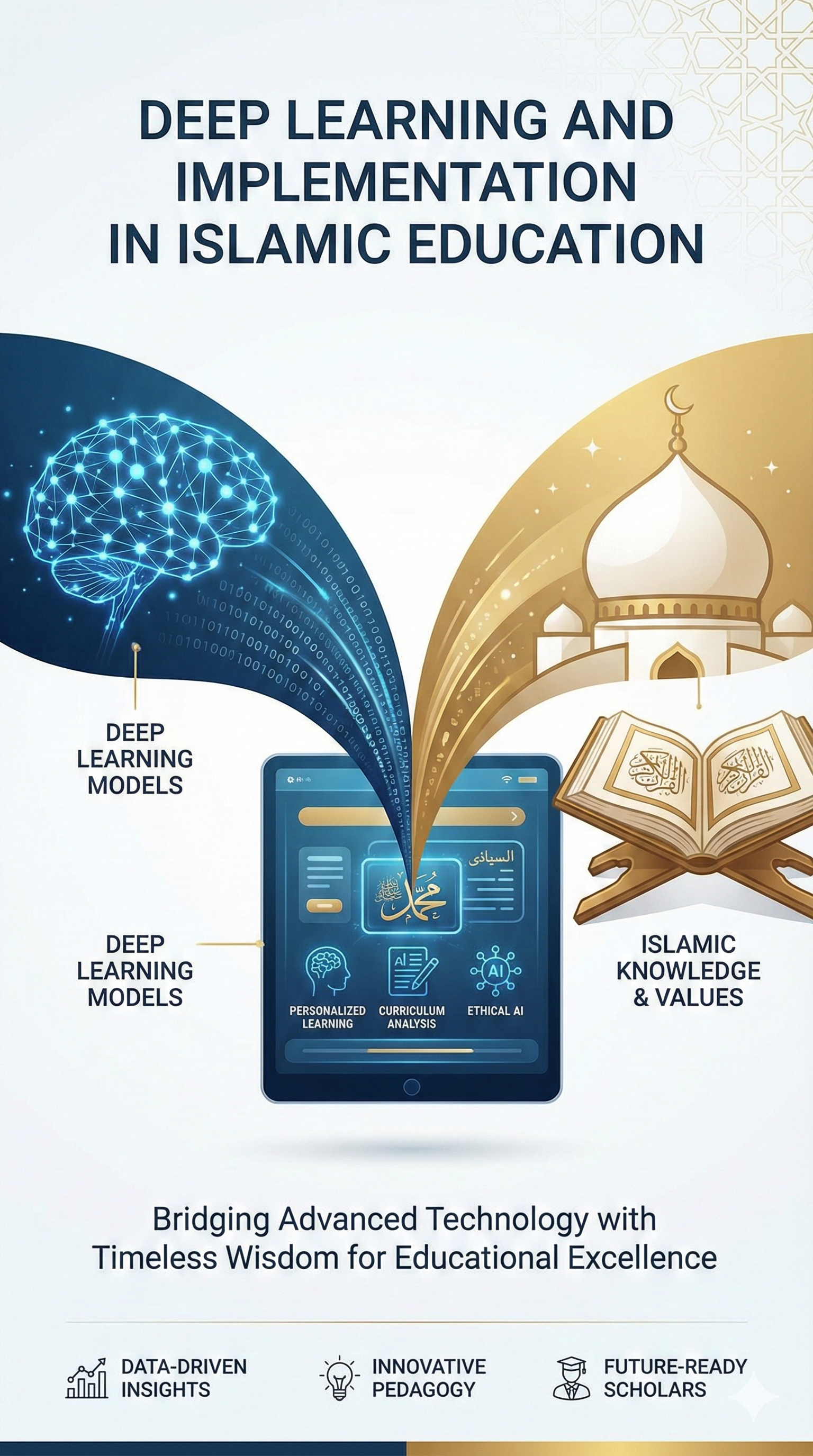
Deep Learning and Implementastion in Islamic education
- Authors
-
-
-
Rizaldy Alpiansyah
Sekolah Tinggi Agama Islam Minhajul HaqAuthor -
Irfan Alkhotiri
Sekolah Tinggi Agama Islam Minhajul HaqAuthor
-
- Keywords:
- Deep learning, Meaningful Learning, Islamic Education, Islamic Pedagogy
- Abstract
-
This article examines the concept of deep learning as a contemporary pedagogical approach and critically relates it to the praxis of Islamic Education. Deep learning emphasizes conceptual understanding, critical reflection, learner engagement, and the construction of meaningful knowledge, rather than rote memorization or surface-level comprehension. In this framework, learning is understood as a transformative process that enables learners to internalize knowledge, connect ideas across contexts, and apply their understanding to real-life situations. Such an orientation aligns closely with the philosophical foundations of Islamic Education, which seeks to develop the human being holistically through the integration of intellectual, spiritual, moral, and social dimensions.
Islamic Education is positioned in this article as a strategic and fertile domain for the implementation of deep learning, as its educational objectives inherently encompass cognitive, affective, and psychomotor development. The Islamic pedagogical tradition emphasizes processes of understanding (tafahhum), contemplation (tadabbur), and practice (‘amal ṣāliḥ), which resonate strongly with the principles of deep learning. Through reflective engagement with Qur’anic texts, Prophetic traditions, and socio-cultural realities, learners are encouraged to move beyond textual knowledge toward ethical awareness and responsible action.
Employing a conceptual analysis supported by relevant educational and Islamic scholarship, this article argues that deep learning is highly compatible with the fundamental aims of Islamic Education. Specifically, it supports the formation of individuals who are not only intellectually competent, but also spiritually grounded and morally upright. Consequently, the integration of deep learning within Islamic Education offers a promising pedagogical pathway for cultivating meaningful learning experiences that contribute to personal transformation and social responsibility in contemporary Muslim societies.
- References
-
Al-Attas, S. M. N. (1980). The concept of education in Islam. Muslim Youth Movement of Malaysia.
Al-Ghazali. (2001). Ihya’ ‘ulum al-din (Vol. 1). Dar al-Kutub al-‘Ilmiyyah.
Anderson, L. W., & Krathwohl, D. R. (2001). A taxonomy for learning, teaching, and assessing. Longman.
Arifudin, O. (2022). Penelitian kualitatif dalam pendidikan. Widina Bhakti Persada.
Ausubel, D. P. (1968). Educational psychology: A cognitive view. Holt, Rinehart & Winston.
Baker, T., & Smith, L. (2019). Educ-AI-tion rebooted? Exploring the impact of artificial intelligence on education. Nesta.
Biggs, J., & Tang, C. (2011). Teaching for quality learning at university (4th ed.). Open University Press.
Bloom, B. S. (1956). Taxonomy of educational objectives: The classification of educational goals. Longmans.
Hanafiah. (2021). Metodologi penelitian pendidikan. Refika Aditama.
Johnson, W. G. (2020). Education research using data mining and machine learning. ScholarWorks.
Kolb, D. A. (1984). Experiential learning: Experience as the source of learning and development. Prentice Hall.
Marton, F., & Saljo, R. (1976). On qualitative differences in learning: I—Outcome and process. British Journal of Educational Psychology, 46(1), 4–11.
Nasution, S. (2017). Islamic education and character building. Kencana.
Rahayu, Y. N. (2020). Metode penelitian kepustakaan. Prenadamedia Group.
Sulaeman. (2022). Penelitian deskriptif analitis dalam pendidikan. Alfabeta.
Tilaar, H. A. R. (2015). Critical pedagogy. Rineka Cipta.
TATA KUSUMA, D., Alkhotiri, I., & Alpiansyah, R. (2026). THE RELATIONSHIP BETWEEN PERSONALITY COMPETENCE OF ISLAMIC RELIGIOUS EDUCATION TEACHERS AND STUDENT DISCIPLINE, MORALS, AND RESPONSIBILITY AT SMA NEGERI 1 BANDUNG CITY. Bahrul Ilmi : Journal of Islamic Religious Education, 1(1), 15-27. https://doi.org/10.66891/err47p48
Vygotsky, L. S. (1978). Mind in society: The development of higher psychological processes. Harvard University Press.
- Cover Image
-
- Downloads
- Published
- 2026-01-30
- Section
- Articles
- License
-

This work is licensed under a Creative Commons Attribution-ShareAlike 4.0 International License.
You are free to:
- Share — copy and redistribute the material in any medium or format for any purpose, even commercially.
- Adapt — remix, transform, and build upon the material for any purpose, even commercially.
- The licensor cannot revoke these freedoms as long as you follow the license terms.
Under the following terms:
- Attribution — You must give appropriate credit , provide a link to the license, and indicate if changes were made . You may do so in any reasonable manner, but not in any way that suggests the licensor endorses you or your use.
- ShareAlike — If you remix, transform, or build upon the material, you must distribute your contributions under the same license as the original.
- No additional restrictions — You may not apply legal terms or technological measures that legally restrict others from doing anything the license permits.
Notices:
You do not have to comply with the license for elements of the material in the public domain or where your use is permitted by an applicable exception or limitation .
No warranties are given. The license may not give you all of the permissions necessary for your intended use. For example, other rights such as publicity, privacy, or moral rights may limit how you use the material.
How to Cite
Similar Articles
- Maskur Azka, Moh. Sahlan, PHILOSOPHICAL AND THEOLOGICAL BASIS OF ISLAMIC RELIGIOUS EDUCATION ASSESSMENT: TOWARDS AN INTEGRATED HUMAN DEVELOPMENT PARADIGM , Bahrul Ilmi : Journal of Islamic Religious Education: Vol. 1 No. 2 (2026): Bahrul Ilmi: Journal of Islamic Religious Education
- Dzihni Mutawakkil, Moh. Sahlan, BEYOND GRADES: TRANSFORMING EDUCATIONAL ASSESSMENT REPORTING INTO A LEARNING IMPROVEMENT SYSTEM THROUGH DIGITAL ASSESSMENT AND FEEDBACK PRACTICES , Bahrul Ilmi : Journal of Islamic Religious Education: Vol. 1 No. 2 (2026): Bahrul Ilmi: Journal of Islamic Religious Education
- Harsing, Rizaldy Alpiansyah, Irfan Alkhotiri, PAI LEARNING IN INTEGRATED SCHOOLS, ISLAMIC BOARDING SCHOOLS, AND INTERNATIONAL SCHOOLS , Bahrul Ilmi : Journal of Islamic Religious Education: Vol. 1 No. 1 (2026): Bahrul Ilmi: Journal of Islamic Religious Education
- Isrun Abdurahman, Rizaldy Alpiansyah, Irfan Alkhotiri, The Construction of Islamic Boarding School Education Ethics in Shaping the Character of Students: An Analysis of Discipline Policy in Islamic Boarding Schools , Bahrul Ilmi : Journal of Islamic Religious Education: Vol. 1 No. 1 (2026): Bahrul Ilmi: Journal of Islamic Religious Education
- DENI TATA KUSUMA, Irfan Alkhotiri, Rizaldy Alpiansyah, THE RELATIONSHIP BETWEEN PERSONALITY COMPETENCE OF ISLAMIC RELIGIOUS EDUCATION TEACHERS AND STUDENT DISCIPLINE, MORALS, AND RESPONSIBILITY AT SMA NEGERI 1 BANDUNG CITY , Bahrul Ilmi : Journal of Islamic Religious Education: Vol. 1 No. 1 (2026): Bahrul Ilmi: Journal of Islamic Religious Education
- zamzam zamaludin zamzam zamaludin, Rizaldy Alpiansyah, Irfan Alkhotiri, Pembiasaan Adab Islami (Salam, Doa, dan Sopan Santun) dalam Membentuk Karakter Anak di Daycare Minhajul Haq , Bahrul Ilmi : Journal of Islamic Religious Education: Vol. 1 No. 1 (2026): Bahrul Ilmi: Journal of Islamic Religious Education
- Eko Budi Prasetyo, Naia Putri Az zahra, Khansa, Konsep Pendidikan Islam dalam Surah Al-‘Alaq Ayat 1–5 : Tinjauan Epistemologis dan Implementasinya di Era Digital , Bahrul Ilmi : Journal of Islamic Religious Education: Vol. 1 No. 2 (2026): Bahrul Ilmi: Journal of Islamic Religious Education
- Ahmad Faruq, Moh. Sahlan, Model Evaluasi Pembelajaran PAI dalam Perspektif Kurikulum Berbasis Cinta , Bahrul Ilmi : Journal of Islamic Religious Education: Vol. 1 No. 2 (2026): Bahrul Ilmi: Journal of Islamic Religious Education
- Dias Nurfadillah, KURIKULUM PENGASUHAN SANTRI BERBASIS FITRAH BERBASIS FITRAH PADA PONDOK PESANTREN MINHAJUL HAQ PURWAKARTA , Bahrul Ilmi : Journal of Islamic Religious Education: Vol. 1 No. 2 (2026): Bahrul Ilmi: Journal of Islamic Religious Education
- Isrun Abdurahman, Rizaldy Alpiansyah, Irfan Alkhotiri, Miftah Wangsadanureja, Tatang Hidayat, Wahabisme: Istilah Yang Dibangun Untuk Membendung Dakwah Tauhid (Analisis Historis, Teologis, Dan Sosiopolitik) , Bahrul Ilmi : Journal of Islamic Religious Education: Vol. 1 No. 1 (2026): Bahrul Ilmi: Journal of Islamic Religious Education
You may also start an advanced similarity search for this article.
Most read articles by the same author(s)
- Isrun Abdurahman, Rizaldy Alpiansyah, Irfan Alkhotiri, Miftah Wangsadanureja, Tatang Hidayat, Wahabisme: Istilah Yang Dibangun Untuk Membendung Dakwah Tauhid (Analisis Historis, Teologis, Dan Sosiopolitik) , Bahrul Ilmi : Journal of Islamic Religious Education: Vol. 1 No. 1 (2026): Bahrul Ilmi: Journal of Islamic Religious Education
- zamzam zamaludin zamzam zamaludin, Rizaldy Alpiansyah, Irfan Alkhotiri, Pembiasaan Adab Islami (Salam, Doa, dan Sopan Santun) dalam Membentuk Karakter Anak di Daycare Minhajul Haq , Bahrul Ilmi : Journal of Islamic Religious Education: Vol. 1 No. 1 (2026): Bahrul Ilmi: Journal of Islamic Religious Education
- Isrun Abdurahman, Rizaldy Alpiansyah, Irfan Alkhotiri, The Construction of Islamic Boarding School Education Ethics in Shaping the Character of Students: An Analysis of Discipline Policy in Islamic Boarding Schools , Bahrul Ilmi : Journal of Islamic Religious Education: Vol. 1 No. 1 (2026): Bahrul Ilmi: Journal of Islamic Religious Education
- DENI TATA KUSUMA, Irfan Alkhotiri, Rizaldy Alpiansyah, THE RELATIONSHIP BETWEEN PERSONALITY COMPETENCE OF ISLAMIC RELIGIOUS EDUCATION TEACHERS AND STUDENT DISCIPLINE, MORALS, AND RESPONSIBILITY AT SMA NEGERI 1 BANDUNG CITY , Bahrul Ilmi : Journal of Islamic Religious Education: Vol. 1 No. 1 (2026): Bahrul Ilmi: Journal of Islamic Religious Education
- Harsing, Rizaldy Alpiansyah, Irfan Alkhotiri, PAI LEARNING IN INTEGRATED SCHOOLS, ISLAMIC BOARDING SCHOOLS, AND INTERNATIONAL SCHOOLS , Bahrul Ilmi : Journal of Islamic Religious Education: Vol. 1 No. 1 (2026): Bahrul Ilmi: Journal of Islamic Religious Education